

My name is Lauren Whitmore, and by trade, I am a forensic accountant. I earn my paycheck by identifying anomalies—spotting the singular, out-of-place digit that reveals a lie within a mountain of financial truth.
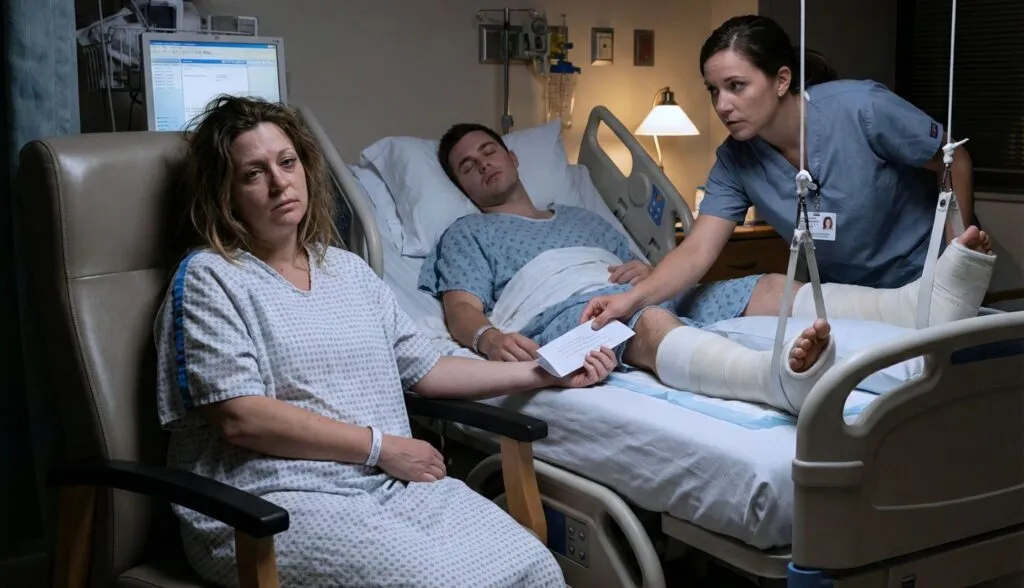
However, three nights into my husband’s hospitalization, my professional instincts had completely abandoned me. Caleb Whitmore lay in the hospital bed beside me, both of his legs encased in thick, heavy plaster, suspended by a complex network of ropes and pulleys. The air in the room was stale, carrying that distinct, suffocating scent of antiseptic and starched, old linen.
It was approaching three in the morning, the witching hour when hospitals cease to feel like centers of healing and transform into silent warehouses for human fear. I hadn’t managed a proper night’s sleep in days, and my mind felt frayed.
I sat curled tight in an uncomfortable folding chair, terrified that even the slightest shift in my weight would creak, waking him and triggering another agonizing wave of pain. Caleb let out a soft moan in his sleep, beads of sweat glistening on his forehead.
To any outside observer, he looked utterly fragile. He appeared broken, dependent, and in desperate need of care.
I leaned forward, gently adjusting the blanket over his chest, whispering his name into the dark. I reminded myself that this was the essence of marriage: when one partner stumbles, the other must bear the load. Just as I settled back, the door clicked open.
Rachel Moore, the head nurse, maneuvered her cart into the room. She was an efficient, calm woman, the type who had witnessed too much human suffering to be prone to dramatics. She barely spoke, moving with practiced speed to check the IV line and glance at the rhythmic glowing monitors.
Then, she turned to me and asked, in a hushed tone, if I could step out to the nurse’s station to pick up something for a patient named Celine. As I squeezed past her in the narrow space, I felt something cold and sharp press into the center of my palm. I froze for a fraction of a second.
Rachel didn’t make eye contact; she simply raised a single finger to her lips, a universal command for silence. I walked into the hallway, the blood pounding in my ears so loudly I was certain the sound echoed off the linoleum. Under the buzzing dim light near the supply closet, I unfolded the scrap of paper.
It contained a single sentence, scrawled in hasty, uneven ink. “Check last night’s security camera, he is not asleep.” In that fleeting moment, the tectonic plates of my reality shifted violently.
Before this nightmare in the hospital, I believed my life was constructed on bedrock. I was thirty-two, disciplined, meticulous, and predictable in the most comforting sense of the word. I spent my working hours untangling complex financial fabrications for major corporations and courtrooms.
I was a woman who trusted facts, patterns, and logic, and within the walls of my home, I believed I could trust my marriage. Caleb and I had navigated life together for eight years. He was charming in a subdued way, a man who spoke softly and projected an aura of absolute dependability.
He worked in construction management, frequently discussing long, grueling hours and volatile contracts, but I never pressed him for details. I managed our personal finances, and he handled the rest; the balance felt secure. Then came the accident.
A single phone call had shattered that equilibrium. Caleb had wrecked his car on the highway. The trauma surgeon told me he was fortunate to be breathing, though his legs were catastrophically injured, and the word “wheelchair” hung in the air like an unspoken threat.
From that instant, I ceased to be Lauren the professional and fully inhabited the role of Lauren the wife. I took an indefinite leave of absence. I slept in a plastic chair.
I began to measure my existence in medication doses and visiting hours, telling myself that true love was verified through endurance. During those initial, chaotic days, another figure stepped into our small circle.
Megan Cole, Caleb’s younger cousin who had recently relocated to the city, appeared like a godsend. She was vibrant, chatty, and perpetually available to assist. She ran errands, fetched meals, and organized the mounting paperwork.
When I was too exhausted to string two thoughts together, she filled the void without a murmur of complaint. I remember thinking how incredibly fortunate we were to have her in our corner. I thanked her repeatedly, offering her my total trust.
Looking back now, that blind trust feels almost humiliating, but at the time, I saw no cracks in the picture. I saw a family uniting against a crisis; I saw myself fulfilling the vows of a dutiful wife. I had no concept that while I sacrificed my sleep, my career, and my sanity, a betrayal was being engineered inches from my face.
And I was standing dead center in the plot, blissfully ignorant. After the third sleepless night, exhaustion began to smear the edges of my perception. I told myself that fatigue was the only reason my intuition felt prickly.
But deep down, a quiet alarm was ringing. Caleb complained of agony constantly, yet only when I was within earshot. If a nurse entered the room, his groans would soften significantly.
When Megan was present, his breathing would become shallow and theatrical. Yet, during those rare windows when I stepped out to make a call or grab a coffee, the room felt suspiciously tranquil upon my return. Whenever I attempted to inspect his legs or adjust the casts, Caleb would stop me, gripping my wrist and claiming it was too disturbing to witness—that he couldn’t bear for me to see him in such a state.
I accepted his protests without pushback, interpreting it as dignity; I now realize it was strict control. His phone habits had transformed as well. Before the crash, Caleb never locked his device.
Now, it lived hidden beneath his pillow, screen always facing the mattress. If a notification chimed, he silenced it with lightning speed. When I asked if it was work-related, he claimed he was ashamed of how useless he felt and didn’t want to see the messages.
Megan observed everything. Or, at least, she performed the role of the observant relative perfectly. She would offer me sympathetic, pitying glances, reminding me to rest, insisting I was doing more than enough.
Occasionally, I caught them exchanging looks—brief, unreadable signals—but I brushed them aside. You see, when you love someone, you work incredibly hard to remain blind to what might hurt you. But Rachel’s note was playing on a loop in my mind: “He is not asleep.”












Comments are closed.