
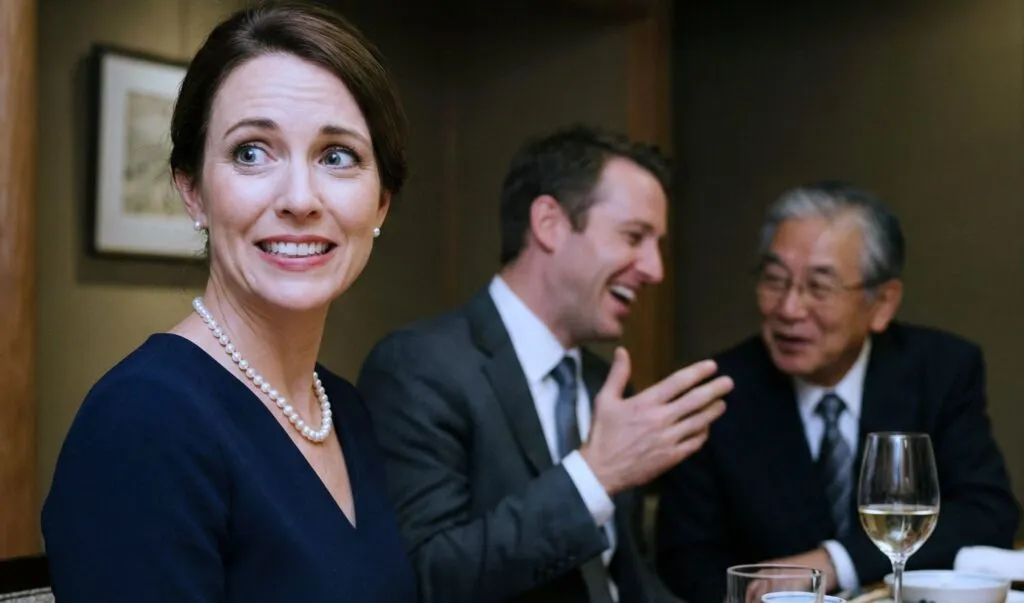
My husband brought me to a high-stakes business dinner as if he were bringing along a silent, decorative prop, expecting me to be nothing more than a pleasant accessory to his ambition. I smiled, I nodded, and I played the role of the devoted, oblivious wife to absolute perfection. What he didn’t know—what he couldn’t possibly have guessed in his wildest dreams—was that I understood every single word of Japanese spoken at that table.
When I heard what he told that client about me, the trajectory of my entire existence shifted in the span of a heartbeat. But to understand the crushing weight of that moment, I need to take you back to where the cracks began. My name is Sarah, and for twelve years, I operated under the comfortable illusion that I had a good marriage.
It wasn’t a fairytale romance, perhaps, but it felt solid, reliable. My husband, David, worked as a senior manager at a prominent tech company in the Bay Area, while I worked as a marketing coordinator at a smaller, less aggressive firm.
My job wasn’t glamorous, but I genuinely found joy in the work. We lived in a lovely townhouse in Mountain View, took a decent vacation once a year, and to any outside observer, we probably looked like a couple who had cracked the code to suburban happiness. But somewhere along the line, the tectonic plates of our relationship had shifted without a sound.
I couldn’t pinpoint the exact moment the drift began. Maybe it started when David received his last major promotion three years ago. Or perhaps it was a gradual erosion, so slow and insidious that I didn’t notice I was drowning until I was already living in a completely different marriage than the one I’d signed up for.
David became busier, more self-important. At least, that was the narrative he fed me. He worked late constantly, traveled frequently for conferences, and on the rare occasions he was home, he was either glued to his phone or too exhausted to engage in real conversation.
Our interactions became entirely transactional, devoid of warmth. Did you pick up my dry cleaning? Don’t forget we have dinner with the Johnsons on Saturday. Can you handle the lawn service? I simply don’t have the time.
I told myself this was normal, that this was simply the inevitable settling of dust after a decade of marriage. The passion fades, the routine sets in, and you just make it work because that’s what adults do. I pushed down the gnawing loneliness that crept in during those quiet evenings when he was locked away in his home office, leaving me to sit alone in the living room, watching television programs I had no real interest in, the silence of the house pressing against my ears.
About eighteen months ago, however, I stumbled onto something that would eventually change my life. I was doom-scrolling through my phone one sleepless night when an advertisement popped up for a free trial of a language learning app, specifically for Japanese. It sparked a memory; I had taken a semester of Japanese in college, back when I was a different person with entirely different dreams.
I remembered how much I had loved it. The complexity of the characters, the elegance of the grammar, the way it forced you to think about the world from a new angle. But then I met David, got married, started my career, and that dream got filed away in a dusty mental drawer labeled “Impractical Interests From Your Youth.”
That night, lying in the dark while David snored beside me, oblivious to my restlessness, I downloaded the app. I did it just out of curiosity, just to see if any of those old neural pathways were still active. To my surprise, I remembered more than I expected. The hiragana characters came back to me more easily than the katakana, but the foundation was there.
Within weeks, I was completely hooked. Every evening, while David worked late or zoned out in front of his financial news channels, I would sit at the kitchen table with my earbuds in, meticulously working through lessons. It became my sanctuary. I subscribed to a podcast for intermediate learners, started watching Japanese dramas with subtitles, and eventually transitioned to watching them without any English aid at all.
I didn’t tell David. Not because I was trying to be deceptive, but because I had learned the hard way not to share things he would likely dismiss. Three years prior, I had mentioned wanting to take a photography class at the community college.
He had laughed—not a villainous cackle, but a dismissive chuckle that made me feel incredibly small.
“Sarah, you take pictures with your iPhone like everyone else,” he had said, shaking his head. “You don’t need a class for that. Besides, when would you even have time?”
After that incident, I learned to keep my personal interests quiet. It was simply easier than defending them against his casual condescension. So, Japanese became my secret garden, my private world where I was competent and growing. And as it turned out, I was good at it.
Really good. I practiced religiously every day, sometimes for two or three hours at a stretch. I hired tutors for video chats on iTalki, joined online study groups, and even started reading simple Japanese novels.
By the time a year had passed, I could understand conversational Japanese with a high degree of fluency. I wasn’t a native speaker, of course, but I knew enough to follow complex movie plots, understand rapid-fire podcasts, and hold meaningful conversations with my tutors. It felt like I was reclaiming a part of myself I thought I had buried forever.
Every new vocabulary word I learned, every complex grammar pattern I mastered, felt like tangible proof that I was still capable of growth. I was still someone valuable, someone who existed beyond the role of “David’s wife.” Then, one evening in late September, the worlds collided. David came home earlier than usual, radiating an excitement and energy I hadn’t seen directed at me in months.
“Sarah, great news,” he said, loosening his tie as he walked into the kitchen where I was chopping vegetables for dinner. “We’re close to finalizing a partnership with a major Japanese tech company. This could be huge for us.”
He grabbed a beer from the refrigerator. “The CEO is visiting next week, and I’m taking him to dinner at Hashiri. You’ll need to come.”
I looked up from the cutting board, surprised. “Me? To a business dinner?”
“Yeah, Tanaka-san specifically asked if I was married,” David explained, taking a swig of his drink. “It’s a Japanese business culture thing. They like to know you’re stable, family-oriented. It’s good optics.”
“You’ll just need to look nice, smile, and be charming,” he continued, waving a hand vaguely. “You know, the usual.”
Something about the way he said “the usual” rankled me, a sharp little thorn of irritation, but I pushed it aside. “Sure, of course. When is it?”
“Next Thursday, 7 p.m. Wear that navy dress, the one with the sleeves. It’s conservative but elegant.”
Then, he turned to look at me directly, his expression serious. “And Sarah, Tanaka doesn’t speak much English. I’ll be doing most of the talking in Japanese.”
“You’ll probably be pretty bored, but just smile through it, okay?”
My heart skipped a beat, thumping loudly in my chest. “You speak Japanese?” I asked, keeping my voice steady.
“Picked it up working with our Tokyo office over the years,” he said, and I could hear the swelling pride in his voice. “I’m pretty fluent now. It’s one of the reasons they’re considering me for the VP position. Not many executives here can negotiate in Japanese.”